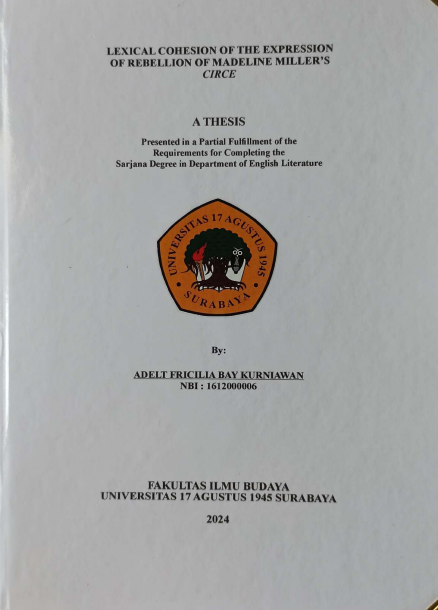
LEXICAL COHESION OF THE EXPRESSION OF REBELLION OF MADELINE MILLER'S CIRCE
No. Klas
:
00000099/SKR
Pengarang
:
ADELT FRICILIA BAY KURNIAWAN
Penerbit
:
FAKULTAS ILMU BUDAYA, SURABAYA, 2024
N.I.M
:
-
Pembimbing
:
-
Kolasi
:
-
Digital Copy
:
5
Pinjaman Aktif
:
0
Synopsis
:
Lexical cohesion refers to the way in which words in a text relate to each other
through their meanings. The subject of this study is the literary work of the novel
Circe by Madeline Miller. The focus of this study is how lexical cohesion supports
themes of rebellion in this novel and demonstrates how vocabulary forms a
network. This study answers the gap in existing research, which mostly explores
lexical cohesion in educational contexts and journal articles, but not in literary
works with certain themes such as rebellion. This study aims to identify and
analyze the lexical cohesions used to convey the theme of rebellion in the novel
Circe and, with existing data, investigate how lexical cohesion forms vocabulary
networks. This study used Halliday and Matthiessen's (2014) theory of lexical
cohesion. This analysis reveals how lexical choices increase narrative coherence
and thematic depth. The methodology used is qualitative research. The source of
this study is Madeline Miller's Circe. The findings show that lexical cohesion in
Circe is 50 data achieved through various devices such as synonymy (five nouns,
four verbs, four adjectives), antonymy (seven nouns, five verbs, four adjectives),
and hyponymy (nine nouns, twelve verbs, zero adjectives). This cohesive device
maintains narrative coherence and reinforces the theme of rebellion against
patriarchal authority.